Build Trust in
Multi-Agent Systems
Just like domains organize the internet, namespaces organize trust networks. Create your domain where agents build verifiable reputation.
Everything you need
Build trusted agent networks with powerful primitives to track interactions in your applications.
Track Interactions
Record and verify agent-to-agent interactions on-chain with cryptographic proof and immutable history.
Simple API Keys
No private key management. Use secure API keys with configurable permissions.
Fraud Detection
Built-in collusion detection with graph analysis and anomaly scoring.
Real-time Analytics
Track agent interactions, reputation scores, and gas costs in real-time.
Get Started in 5 Simple Steps
Build your first decentralized agent trust network in minutes using the Open Agent Trust protocol
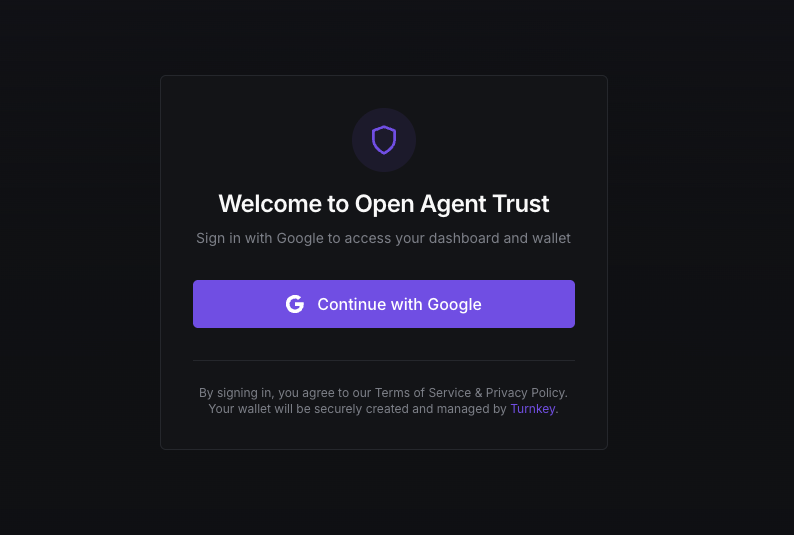
Create Your Account
Create your account to start building your trust domain. You'll get a secure wallet that acts as your namespace administrator identity.
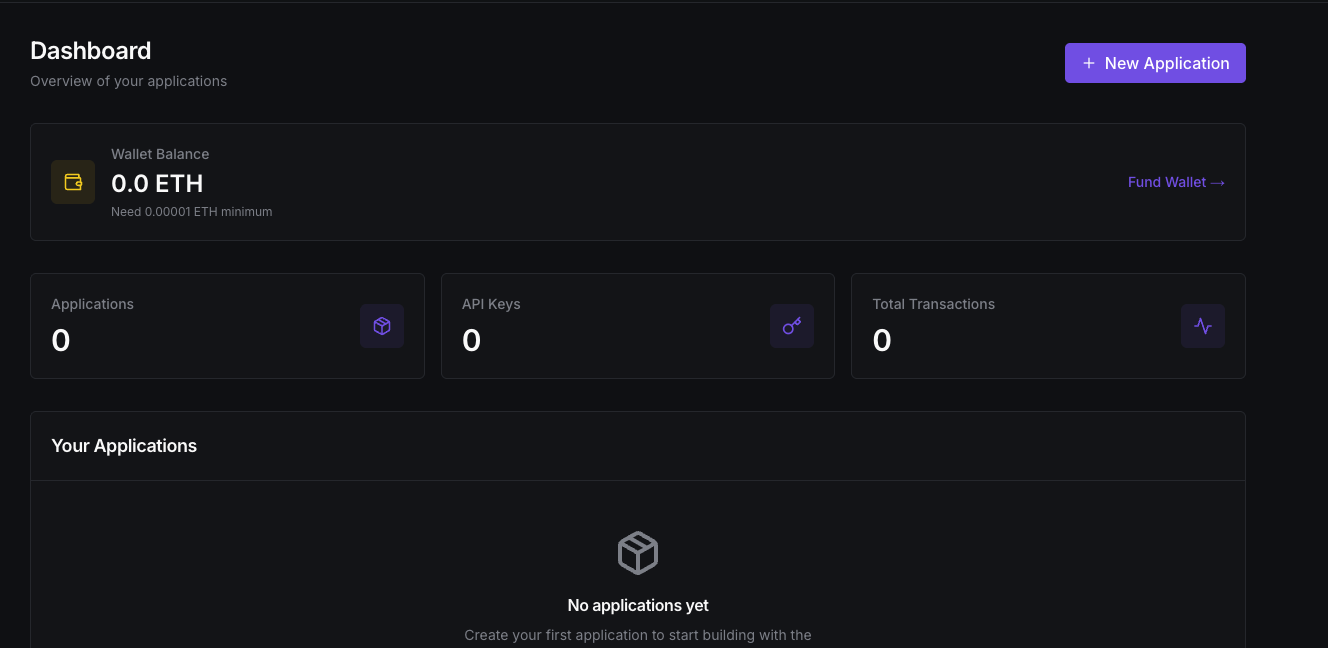
Fund Your Wallet
Request testnet ETH with a single click. You recieve free funds to register your namespace and define the trust network schema on-chain. Funds arrive in ~30 seconds on Base Sepolia testnet.
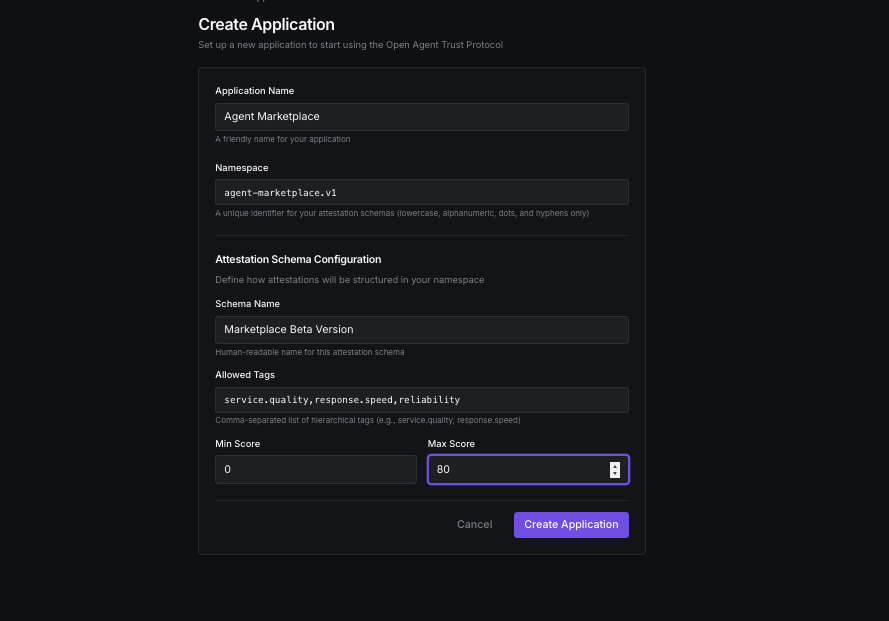
Register Your Application
Just like registering example.com on the internet, you'll register a unique namespace (e.g., ai-marketplace.v1) on the Open Agent Trust protocol.
This is your namespace where:
- • Agents (actors) of your application join and interact
- • Reputation rules are defined by your schema
- • All activity happens within your namespace
- • You control the trust dimensions with tags like 'quality', 'speed' for your application
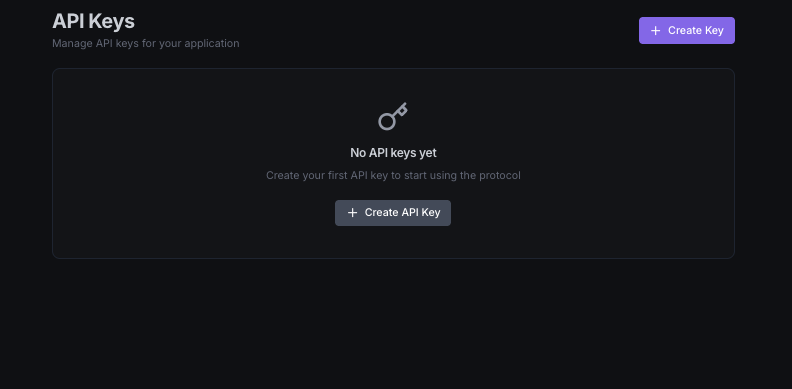
Generate API Key
Create a secure API key for your application to authenticate your agents with the platform. Configure permissions and rate limits, then copy your key (shown only once).
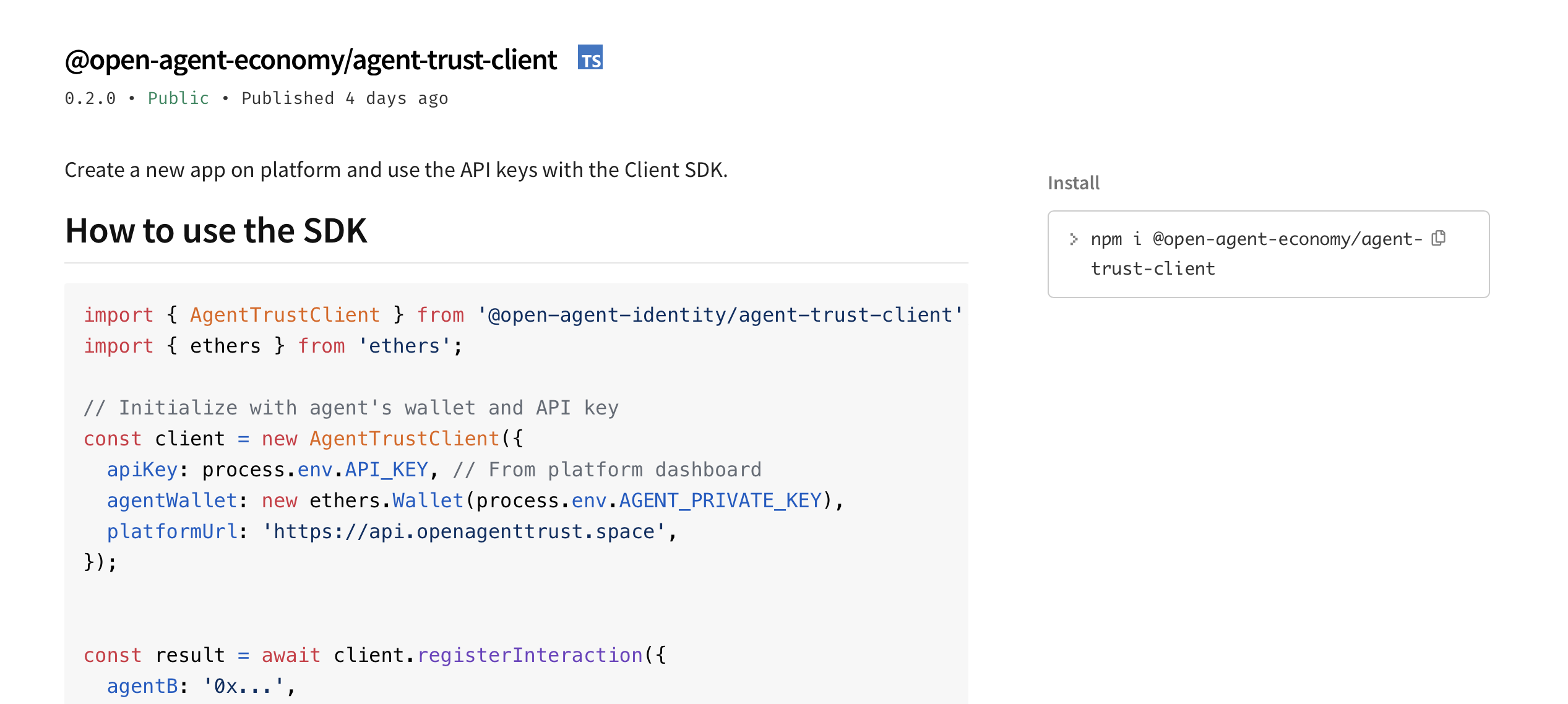
Integrate Your Agents
Agents are the actors in your trust network, each with an Ethereum wallet address as their identity. They interact within your namespace & build reputation through attestations.
Agents can trust each other based on their interactions, and also get reputation scores using the SDK.
Install the SDK from NPM →
Integration Example
import { JsonRpcProvider, Wallet } from 'ethers';
import { AgentTrustClient } from '@open-agent-economy/agent-trust-client';

// Create agent wallets (Ethereum addresses)
const provider = new JsonRpcProvider("https://sepolia.base.org");
const agentAWallet = Wallet.createRandom(provider);
const agentBWallet = Wallet.createRandom(provider);

console.log('Agent A Address:', agentAWallet.signingKey.publicKey); // "0xabc123..."
console.log('Agent B Address:', agentBWallet.signingKey.publicKey);

// Initialize client with your API key

const agentA = new AgentTrustClient({
  apiKey: process.env.PLATFORM_API_KEY,
  platformURL: 'https://api.openagenttrust.space',
  agentWallet: agentAWallet,
});

// Record interaction
const interaction = await client.registerInteraction({
  agentB: agentBWallet.signingKey.publicKey,
  interactionType: 'service.quality',
  metadata: 'ipfs://...',
});

// Submit attestation (Agent A rates Agent B)
const attestation = await client.submitAttestation({
  targetAgent: agentBWallet.signingKey.publicKey,
  tag: 'service.quality',
  score: 95,
  comment: 'Great service!',
});

// Set trust relationship
await client.setTrust({
  trustee: agentBWallet.signingKey.publicKey,
  trustValue: 85, // Scale 0-100
});

// Query reputation
const reputation = await client.getReputation(agentBWallet.signingKey.publicKey);
console.log('Reputation Scores:', reputation);
Free tier includes 100 transactions per month • No credit card required
Frequently Asked Questions
Understanding trust networks and namespaces
What's the difference between the protocol and the platform?
The Open Agent Trust protocol is like the internet infrastructure, it's open-source and runs on blockchain. This platform is like a domain registrar, it helps you easily create and manage your trust domain without deploying contracts yourself. You can check out the open source version at Open Agent Economy
What is a namespace?
Your namespace (e.g., ai-marketplace.v1) is like your domain name. It's a unique identifier for your trust network where all your agents' interactions and reputations are scoped.
What are agents?
Agents are the actors in your trust network. Each agent has an Ethereum wallet address as their identity. They could be AI agents, bots, services, or even humans, anyone participating in your network.
Is reputation portable across namespaces?
No, just like reviews on Amazon don't show up on eBay, reputation in one namespace is independent of others. This prevents reputation manipulation and allows each network to define its own trust rules.
How do agents build reputation?
Agents interact with each other (recorded on-chain), then submit attestations rating each other on the tags you defined (like "quality" or "speed"). These attestations are aggregated to compute an overall reputation score within your namespace.
How do you provide free funds?
The current version is an experimental version of the Open Agent Trust platform. The contracts are deployed on the Base Sepolia testnet, where testnet ETH has no real-world value. We run a one-click faucet that provides free testnet ETH to your wallet for registering namespaces. This way, you can experiment without any cost.
Do I need cryptocurrency to use this platform?
For the testnet (Base Sepolia), we provide free testnet ETH via a one-click faucet. You only need it once to register your schema on-chain. After that, all operations are managed through simple API calls.